Half Truths, Damned Lies, and Copywriting Triumph: My Biggest Winner Revealed
Published: Wed, 12/24/25
Updated: Wed, 12/24/25
Half Truths, Damned Lies, and Copywriting Triumph: My Biggest Winner Revealed
Inside My Biggest Copywriting Win: Insider Secrets from The Great Retirement Betrayal
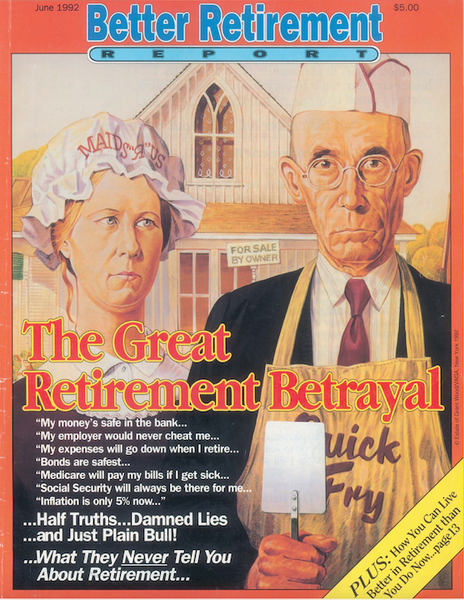
I wrote "The Great Retirement Betrayal" in 1991 as a 20-page magalog for Phillips Investment Resources (now InvestorPlace) to promote The Retirement Letter newsletter, edited by Pete Dickinson.
My style in this piece is
highly conversational and relatable, mimicking a friendly chat over coffee rather than a hard sell.
I use first-person narration from Dickinson's perspective to build immediate rapport, starting with lines like "I suspect that I'm a lot like you.
My retirement is serious business." This creates an empathetic, "one-of-us" tone that draws
readers in by mirroring their concerns.
The language is straightforward, urgent, and emotional—employing short sentences, exclamations ("WRONG!"), and rhetorical questions ("I'll bet your banker never told you that!") to maintain momentum.
I avoid jargon, opting for vivid, fear-evoking imagery (e.g., "getting blind-sided gives me the chills") while blending authority
with accessibility. The overall voice is passionate and crusader-like, positioning the writer as a whistleblower exposing "betrayals" by banks, insurers, and government entities.
Breakdown of Why It Was So Successful
This magalog was a blockbuster in direct mail history—I mailed it over 25 million times over three years, beating the previous control by 100%, and it generated over $250,000 in royalties for me. It
held as the unbeatable control until legendary copywriter Eugene Schwartz dethroned it, only for me to reclaim it six months later.
Industry expert Denny Hatch, editor and publisher of Who's Mailing What!, praised it in the March 1992 issue as "the state of perfection" for the magalog format, noting its seamless blend of editorial content and sales pitch.
He wrote: "The magalog format is not only alive and well, but has reached the state of perfection with this effort for The Retirement Letter... It is the quintessential example of this splendid direct mail genre."
Richard Stanton-Jones, the publisher at Phillips, shared his
enthusiasm by saying: "I want to make Doug D'Anna richer than his wildest dreams so that nobody will be able to afford to tap his wonderful talent." He also relayed a key caveat to magalog creators: a red border around the cover is not allowed, as Time magazine has a patent on that design and rigorously enforces it.
Key factors in its success:
Timeliness and Relevance: I released it amid the early 1990s Savings & Loan crisis, bank failures (e.g., Bank of New England), and insurance bankruptcies (e.g., Executive Life), tapping into real fears of pre-retirees (professionals over 45) about losing their nest eggs.
Headlines like "The Great Retirement Betrayal" and subheads exposing "lies" resonated
deeply during economic uncertainty.
High Engagement and Response Rate: The format disguised the ad as a "special report," encouraging readers to consume it like a magazine rather than junk mail.
This led to massive subscriptions for The Retirement Letter, with me crediting its "buzz" rippling through the industry.
Proven ROI: It not only launched my career (leading to work with major publishers like Agora and Forbes) but also demonstrated long-copy's power, as readers stayed engaged through 20 pages of value-packed content.
Emotional Hook and Trust-Building: By agitating fears and offering solutions (e.g., safest banks, free guide),
it converted anxiety into action, resulting in high conversion rates.
Here is The list of Techniques I Used to Create a Blockbuster
AIDA Formula (Attention, Interest, Desire, Action)
I grab attention with fear-based headlines, build interest through stories, create desire with promises of security, and end with clear calls
to action.
Example: Attention: Cover headline "The Great Retirement Betrayal" with "Half Truths... Damned Lies and Just Plain Bull!"; Action: Repeated offers for the free "RETIREMENT WEALTH-BUILDING GUIDE."
Problem-Agitate-Solve
I identify
problems (e.g., banking crisis), agitate with worst-case scenarios (e.g., "your money gets stuck... it could take two years"), then solve with the product (newsletter and guide).
Example: I agitate FDIC's weakness ("just 45¢ of insurance to back up every $100"), then solve with "Safest Place For Your Money Now: U.S. Treasury bills."
Teasers and Bullets I use intriguing bullets on the cover and sidebars to tease content, creating curiosity and skimmability.
Example: Cover bullets: "What the FDIC Doesn't Want You to Know," "4 BIG NAME life insurance companies that could cost you your financial future."
Credibility
Building
I establish authority through bios, testimonials, and "insider" revelations.
Example: Dickinson's credentials: Former Senate investigator, author of eight books; Testimonial: "Pete's advice very down-to-earth."
Fear and
Urgency
I amplify risks with bold claims and negations (e.g., "MUM'S THE WORD WHEN IT COMES TO THE BANKING CRISIS").
Example: "If another money center bank... goes under, there won’t be enough 'insurance' to go around."
Sidebars and Visual Elements
I incorporate lists, charts, and boxes for quick reads, breaking up text (e.g., "9 Safest Banks In America").
Example: Boxes like "Top 10 U.S. Insurance Companies" and growth fund charts.
Storytelling and Relatability
I weave a personal
narrative to humanize the pitch.
Example: "Years ago I discovered I was being led down a dangerous path... But with what I know now..."
Free Offer as Hook I dangle a valuable freebie to lower barriers.
Example: "FREE copy of 'THE RETIREMENT WEALTH-BUILDING GUIDE'" with state-specific bank lists and investments.
How I Put This Together
I assembled this as my first major "A-level" project, starting from scratch without prior big-client experience. I followed a simple, repeatable formula I later shared in my video How to Write Long Copy That Makes Money (a 1992
presentation to newsletter publishers):
Research Phase: I immersed myself in current events (e.g., GAO reports on bank failures, S&P downgrades) and audience pain points (retirement fears). I emulated successful magalogs, studying controls like Jim Rutz's, which I beat.
Structure Building: I designed it as a
magalog to look like a legitimate report—cover mimicking a magazine (e.g., "June 1992 Better Retirement Report"), with table of contents, articles, and visuals. I started with a strong hook (personal story), built through "deadly traps," and ended with upsell to the newsletter. The idea for the cover—a parody of Grant Wood's "American Gothic" with the couple in modern, downtrodden retirement roles—came from publisher Richard Stanton-Jones.
Writing Process: I wrote in a stream-of-consciousness style, focusing on passion ("communicate your passion through your words"). I used short paragraphs, subheads, and transitions like "Continued on page X" to mimic editorial flow. I incorporated data-driven lists (e.g., safest banks) for credibility.
Testing and Iteration: I tested head-to-head against existing controls,
refining based on response. The piece's success came from its "no-fluff" practicality, as I emphasized in later analyses: "pure red meat you can pick up and run with." I credit starting small and scaling ideas, noting anyone can "start from scratch and rise to the top" by applying 1-2 key ideas.
The Secret of Its Success
The core secret, as I reflect in my teachings, lies in emotional resonance combined with disguised value: It didn't sell a newsletter outright but exposed a "conspiracy" of betrayals, turning fear into empowerment.
By formatting it as an informative "special report" rather than an ad, it bypassed reader skepticism—people read it cover-to-cover, feeling informed rather than sold to.
This, paired with perfect timing
(economic turmoil) and a risk-free offer, created massive trust and urgency. I sum it up: "If you don't communicate your passion... you are not going to sell as much."
Ultimately, its enduring control status proves the power of long-form copy that feels personal and urgent, generating not just sales but industry legend status.
This Volume 1 packs 233 pages of hand-picked winners to inspire your next email, landing page, or VSL with proven headlines, leads, transitions, subheads, bullets, "cookies" for desire, and calls-to-action that close sales.
Here are the 10 promotions included:
The Great Retirement Betrayal
One Nation Under China
Tap the Hidden Wealth Inside Your Paycheck
The One Stock That Will Make You a Marijuana Millionaire
The New Science of Getting What You Want
The Fast Money 2020 $1 Million Giveaway
Oil Time Bomb to Blindside U.S. Investors
The Lightning-Fast Profits
Summit
The Retirement Club
The Master Key to Marijuana Profits
Regularly $350 (just $35 per swipe), but as a special holiday offer on this December 24, 2025, grab it at 50% off for only $175—plus full credit toward my one-on-one coaching program, making it practically free.
As a seasoned direct response copywriter, Doug has created hundreds of profitable direct mail packages, emails, and video sales letters for the world's largest specialized information publishers—generating over $100 million in direct sales.